


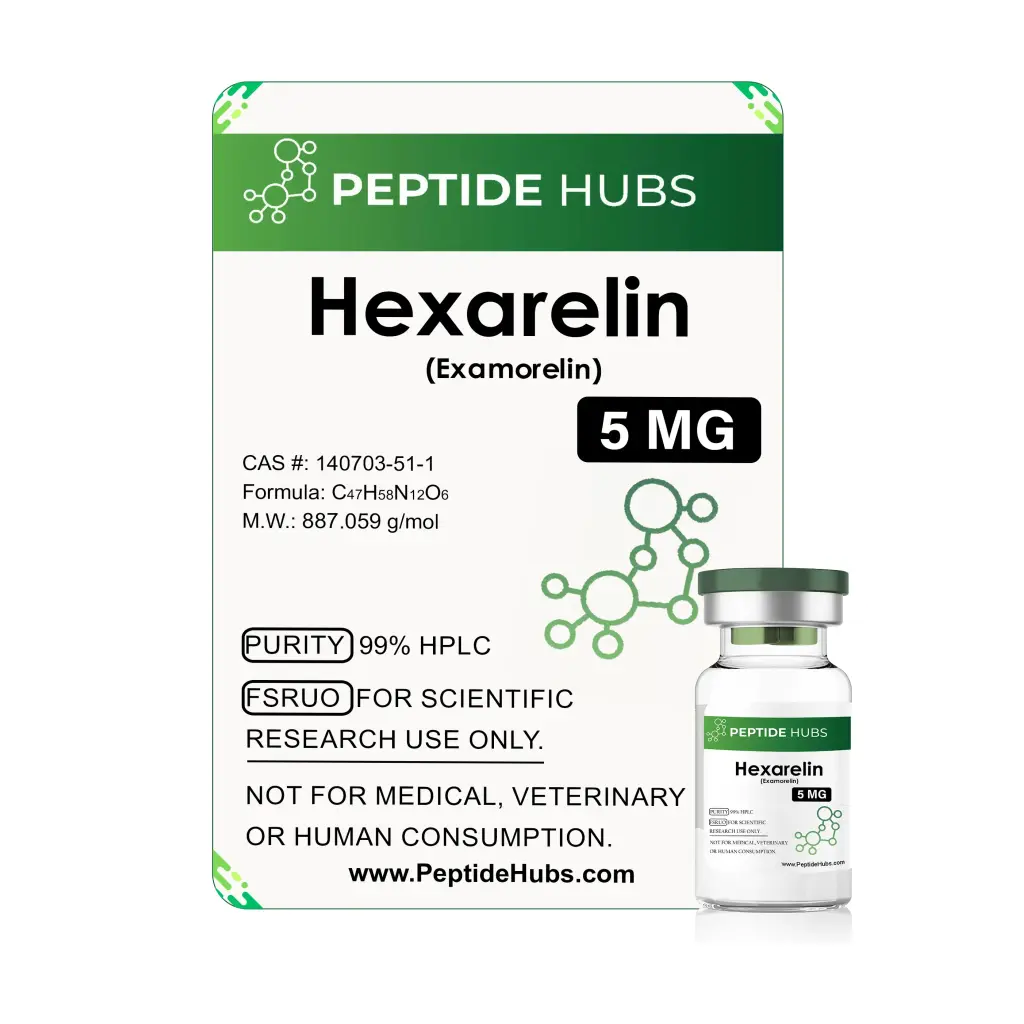
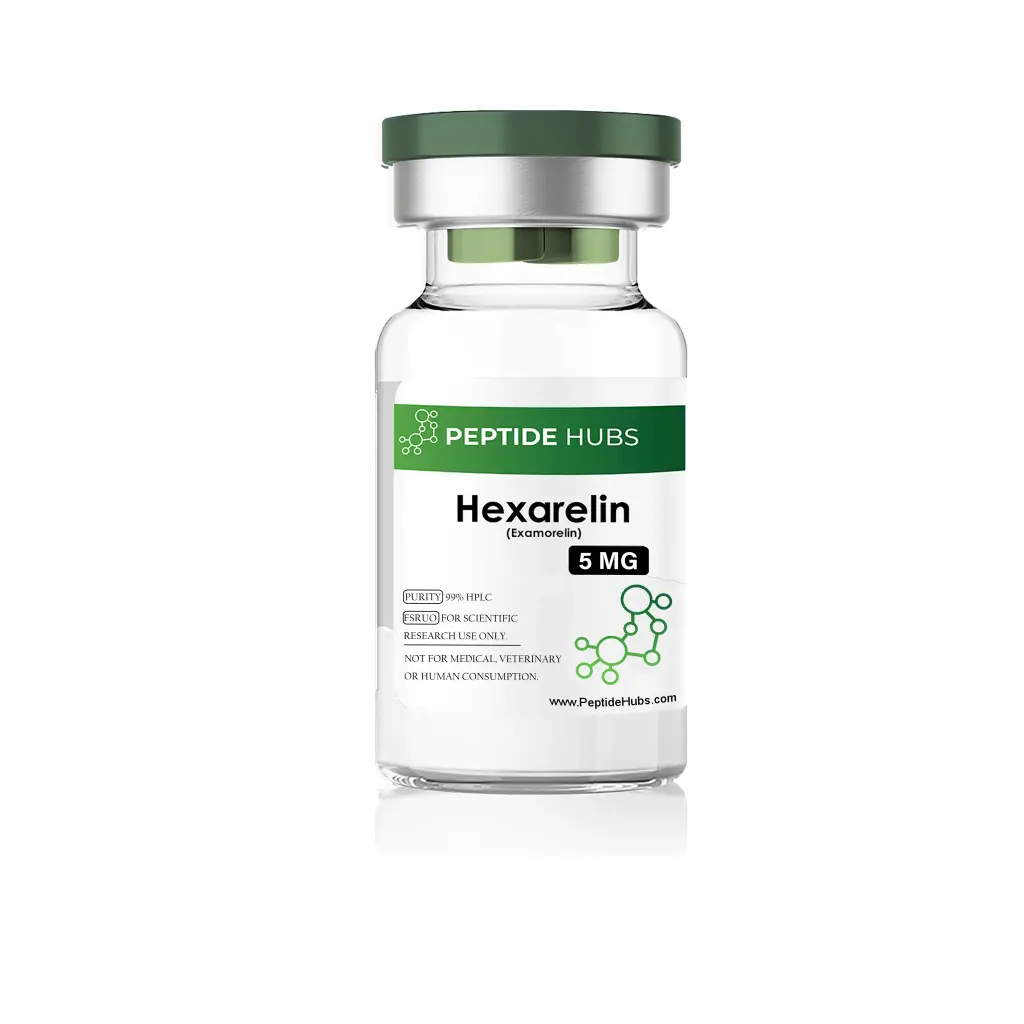
Manufacturer: Peptide Hubs
Pharmaceutical name: Examorelin
Pack: vial (5mg)
Hexarelin, also known as Examorelin, is one of the most aggressive growth hormone releasing peptides available, and athletes don't just use it for growth hormone alone. Hexarelin is widely known for its ability to dramatically increase training aggression, strength output, muscle pumps, and workout intensity.
Hexarelin works by strongly stimulating the ghrelin receptor, triggering powerful GH pulses while also influencing the central nervous system. This combination leads to a unique effect profile: users often feel stronger, more driven in the gym, and able to push heavier weights or higher volume without mental fatigue. This is why Hexarelin is frequently used during hard training blocks, strength-focused phases, and aggressive recomposition cycles.
Unlike milder GH peptides, Hexarelin creates a noticeable "on" feeling. Athletes report deeper pumps, increased blood flow to working muscles, and a heightened mind-muscle connection. For lifters who want to attack training sessions with intensity, Hexarelin delivers a motivational and physical edge that most peptides simply don't provide.
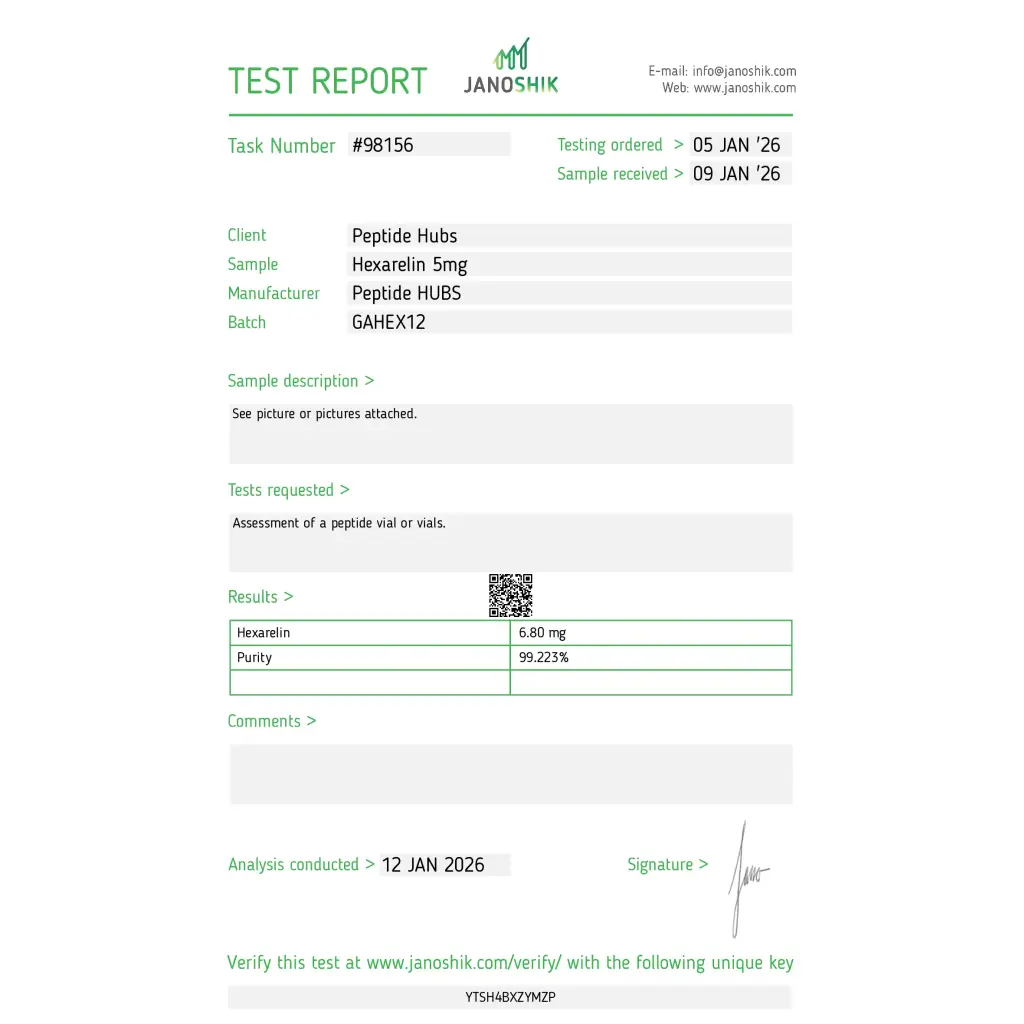
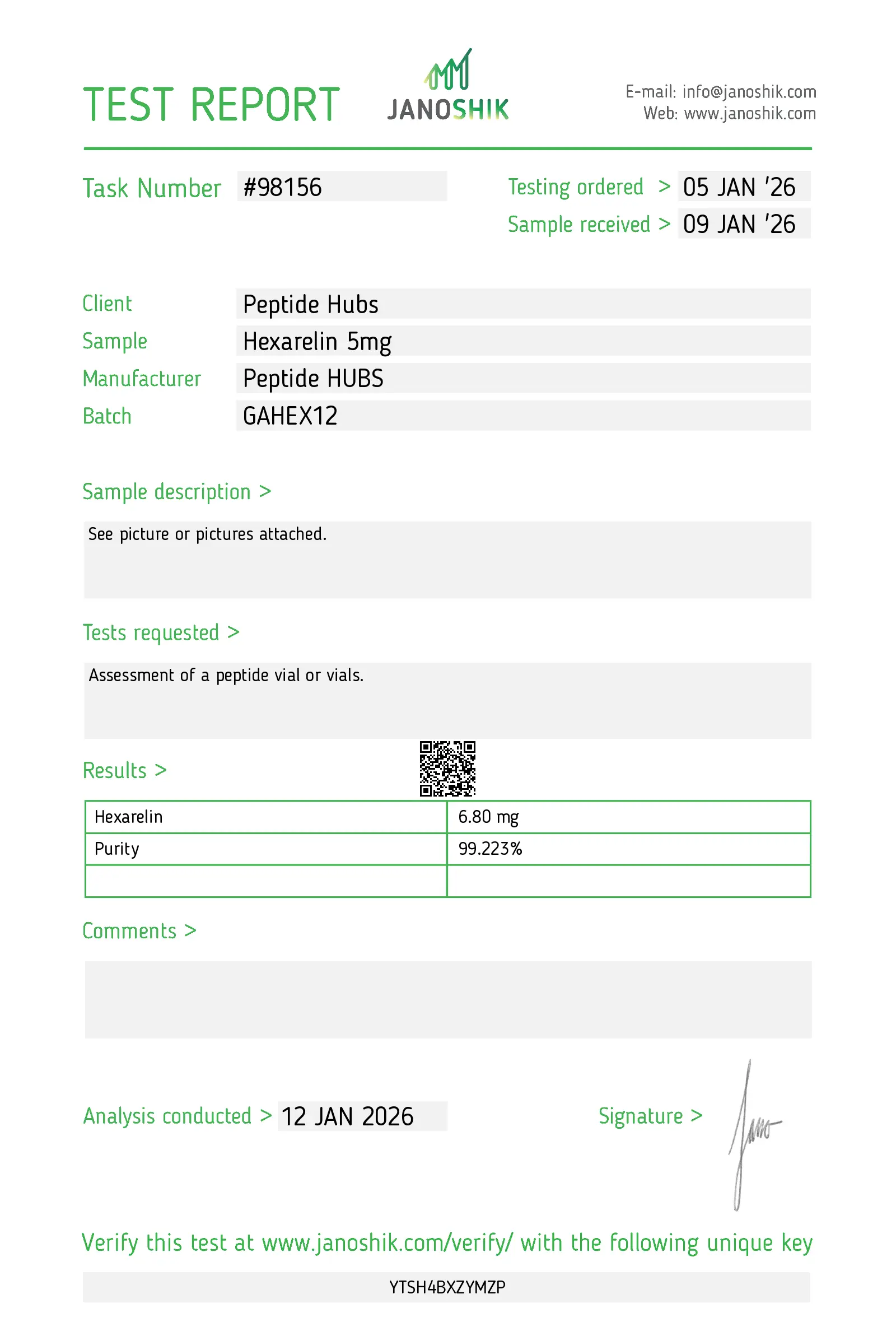
Peptide Hubs Hexarelin is manufactured to high purity standards, ensuring consistent potency and predictable results. This matters with Hexarelin, as dose-response sensitivity is higher compared to peptides like Ipamorelin or Sermorelin. Clean product equals smoother performance benefits and fewer unwanted sides.
Hexarelin increases GH rapidly and forcefully, but its real gym appeal comes from how it impacts training behavior. Users often experience stronger neural drive, better bar speed, and more confidence under heavy loads. This makes Hexarelin ideal for powerlifting blocks, strength-focused bodybuilding phases, or any time intensity needs to be pushed higher.
The peptide also enhances muscle pumps by increasing blood flow and nutrient delivery to muscle tissue. Pumps feel harder and last longer, which not only improves training feedback but may also support better hypertrophy signaling over time.
• Increased strength output and training aggression
• Harder, fuller muscle pumps during workouts
• Improved focus and mind-muscle connection
• Strong GH pulses supporting recovery between sessions
• Enhanced motivation during heavy or high-volume training
• Ideal for advanced lifters who want a noticeable effect
Typical Hexarelin dosing for performance use ranges between:
• 100-200 mcg per injection
• 1-2 injections per day
Many athletes prefer using Hexarelin pre-workout or post-workout to take advantage of the aggression and pump effects. Cycling is recommended, as Hexarelin can desensitize receptors over time.
Common approach:
• 4-6 weeks on
• 2-4 weeks off or switch to a milder GHRP
Hexarelin stacks extremely well with peptides that balance its intensity:
• CJC-1295 DAC - extends GH elevation and supports recovery
• IGF-1 LR3> - enhances hypertrophy and muscle fullness
• BPC-157 - supports joints and connective tissue during heavy lifting
This combination allows athletes to push strength and volume while protecting recovery and tissue health.
| Peptide | Training Feel | Strength Impact | Best Use |
|---|---|---|---|
| Hexarelin | Very aggressive | High | Heavy training & power phases |
| Ipamorelin | Mild | Low | Recovery & longevity |
| GHRP-6 | Moderate | Medium | Mass & appetite support |
Does Hexarelin increase strength?
Yes. Many users report noticeable increases in strength, aggression, and confidence under heavy loads.
Is Hexarelin good for pre-workout use?
Yes. Some athletes use Hexarelin before training for stronger pumps and heightened focus.
Is Hexarelin stronger than Ipamorelin?
Yes. Hexarelin is significantly more aggressive and noticeable than Ipamorelin.
Can Hexarelin be stacked with anabolic cycles?
Yes. It is commonly used alongside steroid or SARM cycles to boost training intensity and recovery.
Should Hexarelin be cycled?
Yes. Cycling helps prevent receptor desensitization and keeps results consistent.
| Tier | Amount per dose | What it means |
|---|---|---|
| Dose ranges | ||
| Low | 100 mcg | Cautious starting amount |
| Moderate | 200 mcg | Amount most often used in research, taken 2–3 times a day |
| High | 300 mcg | Top of the range typically discussed |
| Key facts | ||
| Approval status | Research compound only; the FDA has not approved any dose for human use | |
| Half-life | About 70 minutes | |
| Usual route | Injection under the skin (subcutaneous) | |
| Frequency | 2–3 times per day | |
| Highest dose studied | 300 mcg per dose | |
| Possible side effects | These differ from compound to compound; talk to a healthcare provider about any reaction | |
| Disclaimer | Figures are math conversions for reference only, not medical advice | |
| Reconstitution calculator | |
|---|---|
| Find out how much bacteriostatic water to add and how many units to draw on your syringe for your Hexarelin dose. | |
| Peptide in the vial |
mg
|
| Bacteriostatic water |
mL
|
| Dose you want |
mcg
|
| Syringe |
|
| Results | |
| Choose your values and press Calculate. | |
| Concentration | — |
| Amount to draw | — |
| Units to draw | — |
| Doses in the vial | — |
| How the math works | |
| 1. Find the concentration | Divide the peptide in the vial by the water added. For example, 5 mg ÷ 2 mL = 2.5 mg/mL, which is 2,500 mcg/mL |
| 2. Work out the volume | Divide the dose by the concentration. For example, 100 mcg ÷ 2,500 mcg/mL = 0.04 mL |
| 3. Convert to units | On a U-100 syringe, multiply the mL by 100. For example, 0.04 mL = 4 units |
| 4. Check the syringe | Make sure the amount fits the syringe you are using |
| Worked example | |
| Vial | 5 mg hexarelin |
| Water | 2 mL bacteriostatic water |
| Dose | 100 mcg |
| Syringe | 100 units (1 mL) |
| Concentration | 5 mg ÷ 2 mL = 2,500 mcg/mL |
| Amount to draw | 100 mcg ÷ 2,500 mcg/mL = 0.04 mL, which is 4 units on a U-100 syringe |
| Disclaimer | |
| This tool does math conversions only. It does not choose a dose for you or confirm product quality, safety, or medical suitability. | |
Mixing a peptide takes about a minute. What people usually get wrong is what happens afterwards. Work through the steps in the guide above, then store the vial the way we lay out further down.
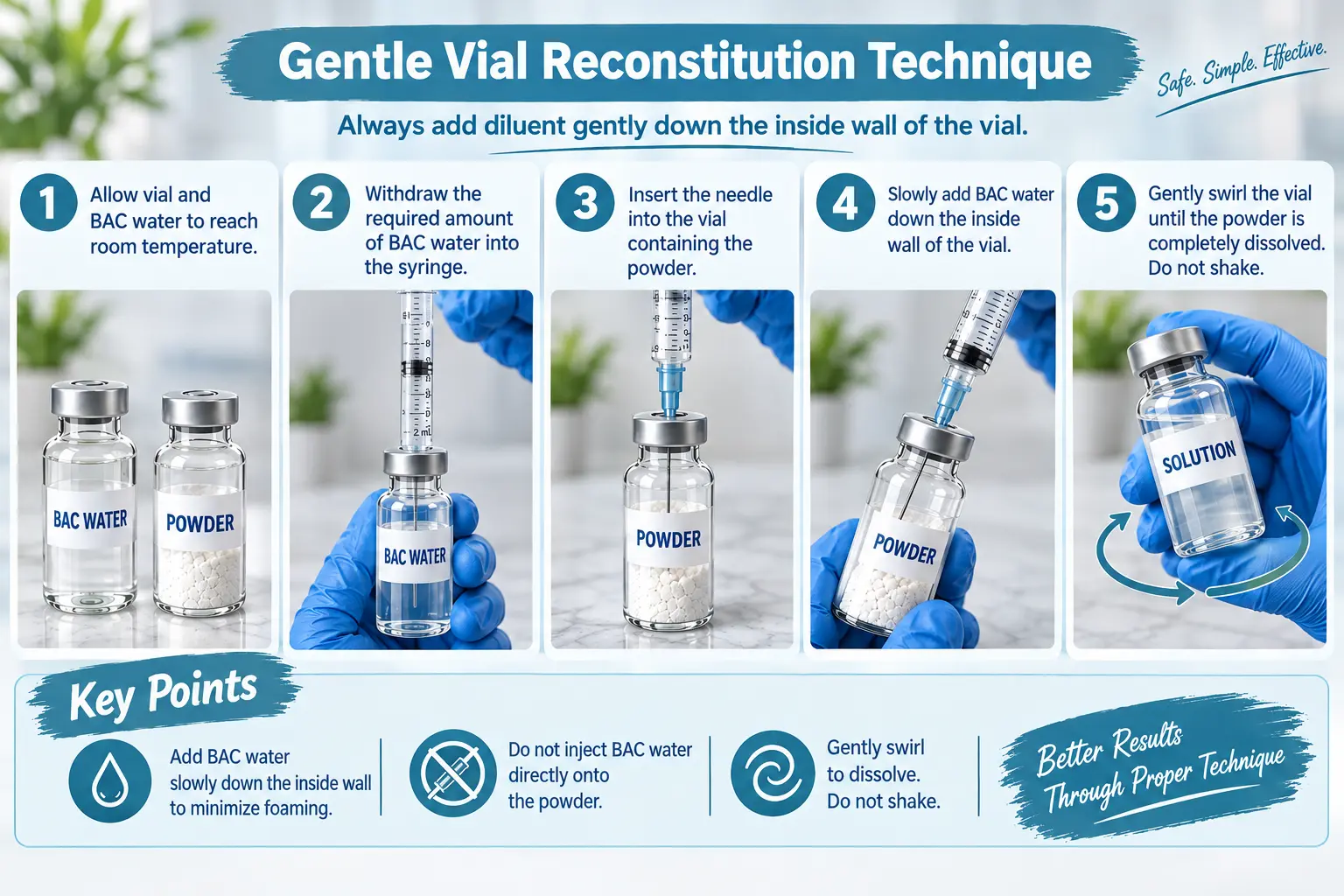
The five steps above cover it. Let the vial and the bacteriostatic water sit out until they reach room temperature. Then run the bacteriostatic water down the inside wall of the vial, slowly, so it does not foam up. Swirl it gently until the powder is gone. Do not shake the vial, and do not squirt the bacteriostatic water straight onto the powder.
As soon as it is mixed, put the vial back in the fridge. 2 to 8°C (35.6°F to 46.4°F) is what you want, and it stays there until you have used it up. Write the mixing date on the label. Do not rely on memory for that.
The dry powder is much easier to keep. Store it dry and away from light, at room temperature if it is only for a short while, or at -20°C for the long term. Only mix what you are going to use.
Please log in to write Hexarelin review.

Manufacturer: Dragon Pharma
Pharmaceutical name: Hexarelin
Pack: vial (5 mg)
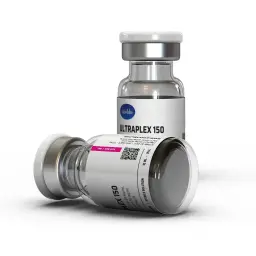
Manufacturer: Axiolabs
Pharmaceutical name: Drostanolone Propionate, Testosterone Propionate, Trenbolone Acetate
Pack: 10 ml vial (150 mg/ml)
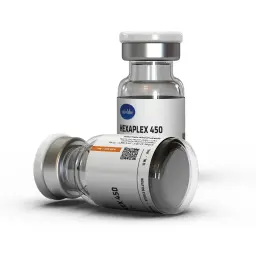
Manufacturer: Axiolabs
Pharmaceutical name: Testosterone Acetate, Testosterone Decanoate, Testosterone Propionate, Testosterone Phenylpropionate, Testosterone Cypionate
Pack: 10 ml vial (450 mg/ml)