



Manufacturer: Stealth Labs
Pharmaceutical name: Survodutide
Pack: 2 ml vial (10mg per vial)
STEALTH - Shipped without label
Survodutide 10mg is a research peptide from Stealth Labs, supplied in a 2 ml vial at 10 mg as lyophilized powder. Its active substance is Survodutide, and Stealth Labs ships it without a label.
Most weight research measures fat on the body. A large share of the work on Survodutide measures fat inside the liver instead, because that tissue responds to the compound in a way that is easier to track.
Survodutide acts on the GLP-1 receptor and the glucagon receptor. The GLP-1 side lowers food intake. The glucagon side raises energy use, and glucagon signalling is also tied to how the liver handles fat. In liver models, studies look at fat storage in the tissue, inflammation markers and how the organ responds over a longer period. That combination is the reason this compound turns up in liver focused research far more than in plain appetite work.
These are research findings only. Survodutide 10mg is sold for laboratory work, not as a medicine.
The unlabeled vial keeps the parcel discreet, and the dry powder holds its strength in transit.
Keep the sealed vial cool, dark and dry. Once mixed, store it in a fridge between 2 and 8 degrees Celsius and use it within a few weeks. Do not shake the vial. Roll it gently between your hands to mix, and keep your tools clean.
Metabolic research usually compares compounds rather than stacking them. Survodutide by Peptide Hubs is the same substance from another maker, and Survodutide 10mg by Dragon Pharma is a second option. Cagrilintide 10mg by Peptide Hubs works on the amylin signal instead. Everything sits in our Weight Loss category.
Why is Survodutide studied for liver fat?
Glucagon signalling affects how the liver stores and releases fat, so the liver is where a lot of the research is done.
Do I need a prescription?
No. You can buy Survodutide 10mg without prescription from our shop.
Is it the same as Mazdutide?
Both are dual agonists, but they are different compounds. Many labs run them side by side to compare.
Adding Survodutide 10mg to your cart takes a minute. Compare it with the Dragon Pharma and Peptide Hubs vials first if you want to test makers, or browse the SARMS and Peptides category for the rest of our stock.
| Level | Dose size | Description |
|---|---|---|
| Dosage levels | ||
| Low | 100 mcg | Conservative entry point |
| Moderate | 250 mcg | Typical amount in research settings |
| High | 500 mcg | Upper limit of the commonly cited range |
| Essential information | ||
| Regulatory status | Sold as a research compound; no human dose has FDA approval | |
| Half-life | Undetermined; estimates differ across sources | |
| Administration | Subcutaneous injection, just beneath the skin | |
| Dosing frequency | One to two times daily | |
| Maximum researched dose | 500 mcg | |
| Reported side effects | Injection-site reactions, nausea, stomach discomfort | |
| Please note | Values are unit conversions provided for reference, not medical guidance | |
| Reconstitution calculator | |
|---|---|
| Find out how much bacteriostatic water to add and how many units to draw on your syringe for your Survodutide dose. | |
| Peptide in the vial |
mg
|
| Bacteriostatic water |
mL
|
| Dose you want |
mcg
|
| Syringe |
|
| Results | |
| Choose your values and press Calculate. | |
| Concentration | — |
| Amount to draw | — |
| Units to draw | — |
| Doses in the vial | — |
| How the math works | |
| 1. Find the concentration | Divide the peptide in the vial by the water added. For example, 5 mg ÷ 2 mL = 2.5 mg/mL, which is 2,500 mcg/mL |
| 2. Work out the volume | Divide the dose by the concentration. For example, 100 mcg ÷ 2,500 mcg/mL = 0.04 mL |
| 3. Convert to units | On a U-100 syringe, multiply the mL by 100. For example, 0.04 mL = 4 units |
| 4. Check the syringe | Make sure the amount fits the syringe you are using |
| Worked example | |
| Vial | 5 mg survodutide |
| Water | 2 mL bacteriostatic water |
| Dose | 100 mcg |
| Syringe | 100 units (1 mL) |
| Concentration | 5 mg ÷ 2 mL = 2,500 mcg/mL |
| Amount to draw | 100 mcg ÷ 2,500 mcg/mL = 0.04 mL, which is 4 units on a U-100 syringe |
| Disclaimer | |
| This tool does math conversions only. It does not choose a dose for you or confirm product quality, safety, or medical suitability. | |
Mixing a peptide takes about a minute. What people usually get wrong is what happens afterwards. Work through the steps in the guide above, then store the vial the way we lay out further down.
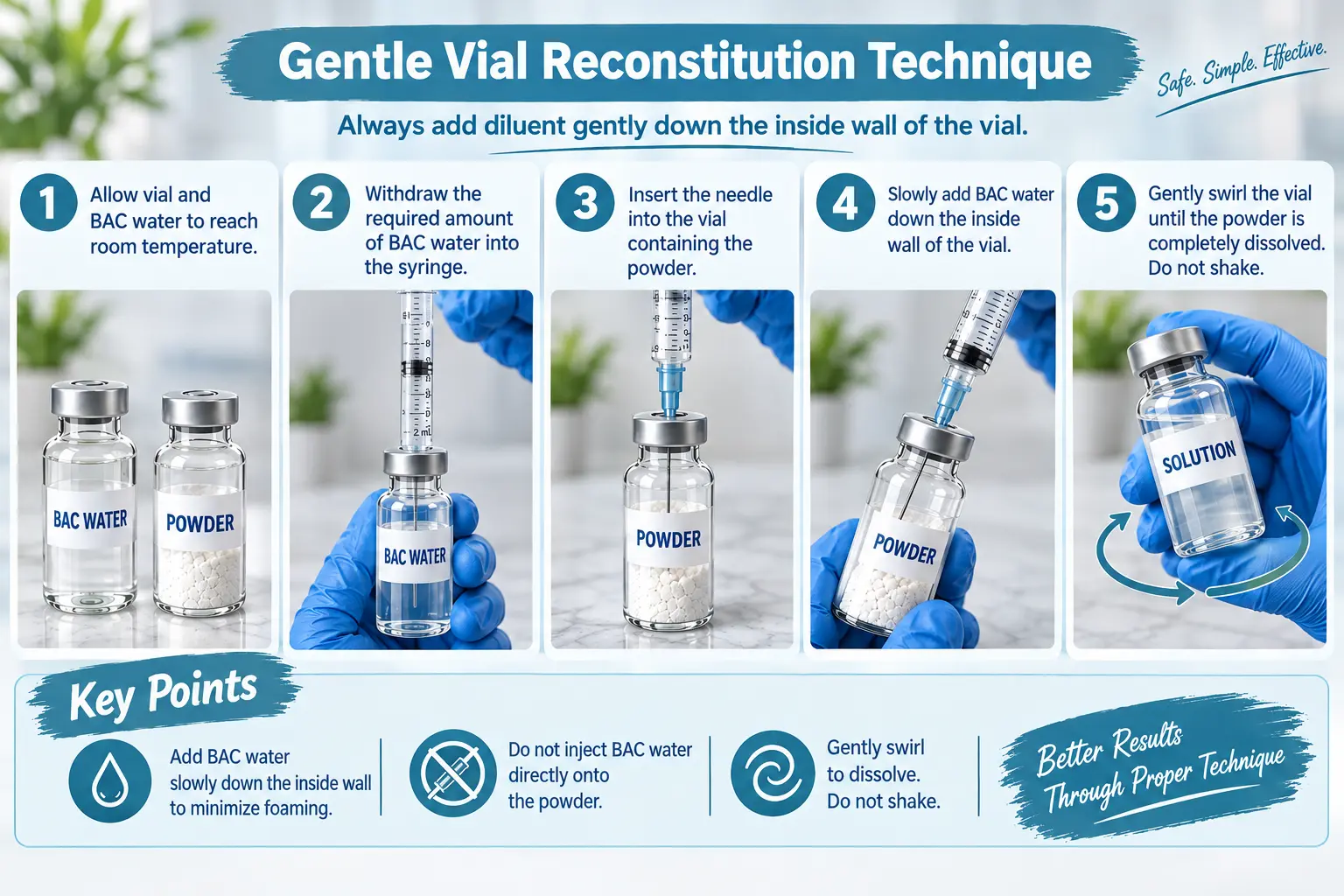
The five steps above cover it. Let the vial and the bacteriostatic water sit out until they reach room temperature. Then run the bacteriostatic water down the inside wall of the vial, slowly, so it does not foam up. Swirl it gently until the powder is gone. Do not shake the vial, and do not squirt the bacteriostatic water straight onto the powder.
As soon as it is mixed, put the vial back in the fridge. 2 to 8°C (35.6°F to 46.4°F) is what you want, and it stays there until you have used it up. Write the mixing date on the label. Do not rely on memory for that.
The dry powder is much easier to keep. Store it dry and away from light, at room temperature if it is only for a short while, or at -20°C for the long term. Only mix what you are going to use.
Please log in to write Survodutide 10mg review.

Manufacturer: Dragon Pharma
Pharmaceutical name: Survodutide
Pack: 2 ml vial (10mg per vial)
Manufacturer: Dragon Pharma
Substance: Cagrilintide
Pack: vial (10mg)
Manufacturer: Dragon Pharma
Pharmaceutical name: Pentadecapeptide
Pack: 2 ml (2 mg)

Manufacturer: Dragon Pharma
Pharmaceutical name: Sibutramine Hydrochloride
Pack: 100 tabs (20 mg/tab)

Manufacturer: Dragon Pharma
Pharmaceutical name: Cardarine
Pack: 100 tabs (20 mg/tab)
Manufacturer: Dragon Pharma
Pharmaceutical name: Thymosin beta 4
Pack: 2 ml vial (5 mg/ml)